[00:00:00] Speaker A: All right, TaylorMade, if any of your reps are listening, we're happy to receive some gifts here in Mexico.
[00:00:06] Speaker B: Please, please do. Entrepreneurs love talking about business.
[00:00:10] Speaker A: However, it's no secret there's also so.
[00:00:13] Speaker B: Many things they love talking about which.
[00:00:15] Speaker A: Are not about business.
[00:00:17] Speaker B: In the sea of business podcasts, NONE of your business is a refreshing break. A surprise kiss, an afternoon fizz.
[00:00:27] Speaker A: Through Carla Singson's cheeky and radical takes on mundane in princip heavy topics, you'll gain insights that guarantee you something to.
[00:00:36] Speaker B: Talk about on your first Tinder date while visiting grandma or if you want to impress your new boss.
[00:00:43] Speaker A: Big thanks to Proximity Outsourcing for sponsoring this episode. Outsource the most tedious tasks in your business, such as data management, appointment setting and creatives for less than $12 an hour, fully managed.
[00:00:57] Speaker B: Visit proximityoutsourcing.com for more info.
[00:01:01] Speaker A: Tired of business podcasts?
[00:01:03] Speaker B: Tune in to none of your Business new episodes weekly.
[00:01:17] Speaker A: Are you spending too much money on ads? Want to increase your average order value? Are you eyeing that big exit from your business? Or have you been wondering how you can increase your lifetime value, build a community and basically make more money through customer loyalty, loyalty and retention. Let us help. Huckleberry Consulting brings over a decade of experience in client and customer success from the world's biggest companies.
Let your customers tell you what they want. Visit consultheckleberry.com to claim your free audit and quit leaving money on the table. Once again, that's consultheckleberry.com See you there. Hey guys, Good morning. This is Carla and welcome to another episode of NONE of your business.
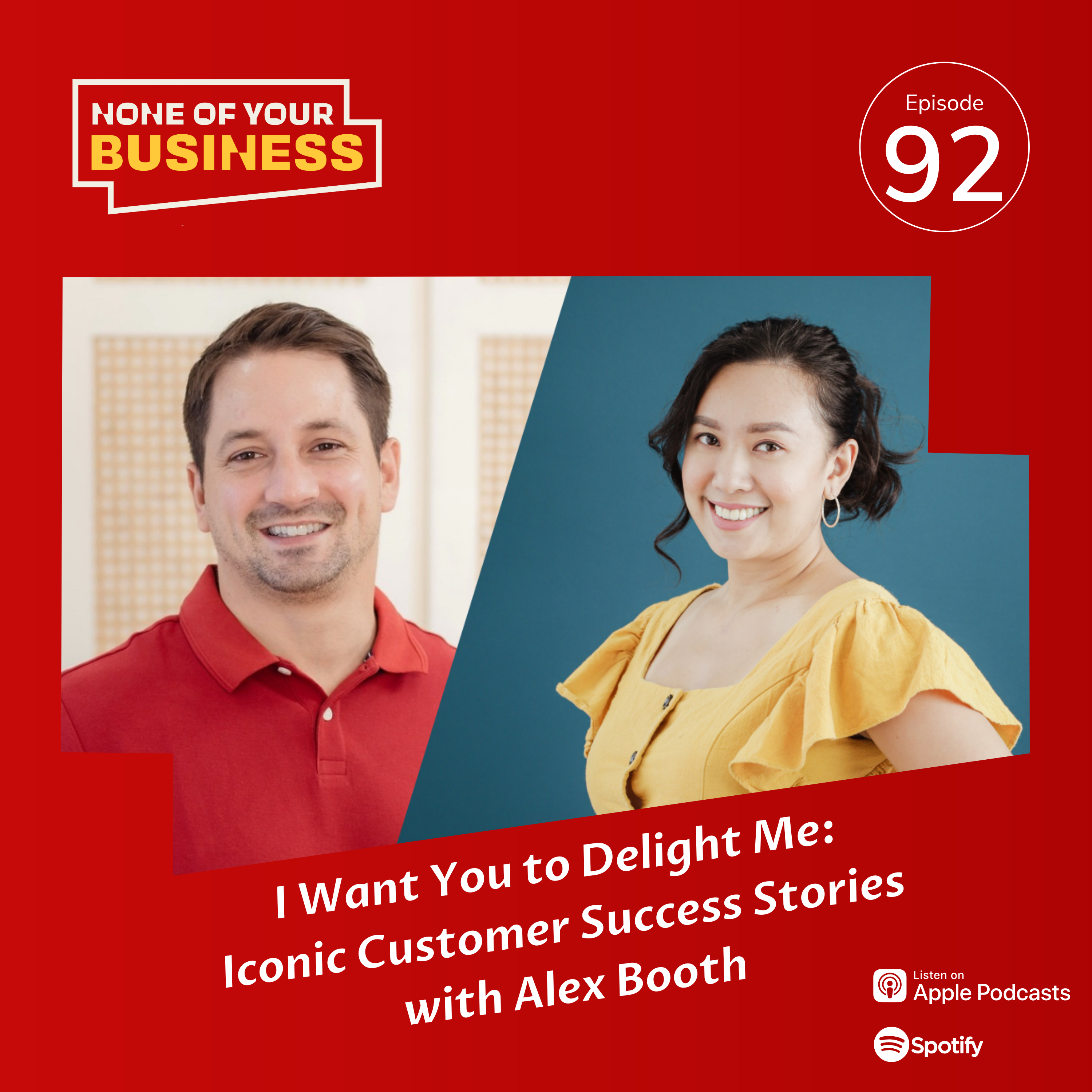
Today we have another returnee on the podcast. It's actually my husband, Alex Booth. He owns a customer success consulting firm called Huckleberry Consulting. Visit their website at, consult huckleberry.com and and getcsm.com which is also spun off of his customer success consulting experience and expertise.
He helps business owners hire high quality client success managers and customer success managers as low as 14 bucks an hour. And you can outsource anywhere in the world or even hire nearshore or higher in your country or wherever you are. So what he brings is a very long experience of customer success expertise, really helping online businesses grow and make more money with better retention, loyalty communities, affiliate partnerships, basically taking care of people, loving people, relationships. That's. I guess that's why this guy tricked me into marrying him. He's really good at relationships, relationship building and so Alex, welcome to my podcast again.
[00:03:15] Speaker B: Hey, thanks for having me back.
[00:03:18] Speaker A: Yeah, I mean, you were really threatening me that I should have you on here. So I was.
[00:03:25] Speaker B: I was. There's a lot of threats.
[00:03:27] Speaker A: No, actually, Alex and I, whenever we travel or we watch, like, random ads, we always talk about business and marketing. Just like me. Trivia for everyone. Just like me. He also graduated in business school, and he graduated. Was it advertising? Marketing.
[00:03:44] Speaker B: With advertising.
[00:03:45] Speaker A: Yeah, advertising. So. And I'm a marketing graduate, so we are both marketing and advertising nerds. And now we're business nerds. So our topic for today is actually linked.
Linked to his experience in customer success, but this is taking from our experience as customers. So in this podcast episode, the title is I want you to delight me, Customer delight from the perspective of customers and a customer success consultant. So we will be sharing 10 ways that we feel delighted as customers, sharing our own experiences and insights. And.
And we feel that since most of you guys are business owners, entrepreneurs, you might get an idea or two that you can put in your business immediately so that you can use these tactics, these strategies, and of course, these principles to grow according to customer loyalty, retention, and basically how much your customers love you. So, of course, that doesn't come by accident. You need to put a lot of effort as a business owner. So I've been talking a lot here. I'll give the floor to Alex for the first way to delight a customer.
[00:04:59] Speaker B: Yeah, first off, I think it's kind of fun that we're talking about positive customer experiences. I feel like majority of the time, you're just saying about how a company really rubbed you the wrong way or pissed you off. So, yeah, it's cool to have a platform to talk about some positive experiences.
Which brings me into my first one, which I'm very excited to talk about, which is kind of added member benefits.
So these are essentially perks that you have received by either being a member or being a customer, and you really enjoyed it.
[00:05:33] Speaker A: And I.
[00:05:33] Speaker B: For me, there's one that really jumped out, and it's one Carla that you and I use all the time. And it came with Chase Sapphire rewards card.
[00:05:42] Speaker A: Right.
[00:05:42] Speaker B: So there's a little bit of an eligibility requirement in order to get a Chase Sapphire card.
You actually turned me onto it. You know, Carla and I live in Mexico, and I was getting hit with just ridiculous amount of international transaction fees, and Carla suggested this card for me, and so I'll give you credit there.
Got the card. And I didn't know that they had all these added benefits. I probably should have looked more into it, to be honest.
But my personal favorite from it is one we use constantly which is a priority pass.
We get access to a lot of airport lounges, and it's simply because I have a priority pass tied to this card. Carla now has a subsidiary card of that as well, which also came with a priority pass. And even without that, I was able to add a guest every single time I enter an airport lounge. So, Carla, we probably use this. Gosh, it seems like once a month we're using it. Oh, yeah, yeah, yeah. And I. Honestly, it is super fun having access to all the lounges. Carla and I are different people now, but. And then I think, Carla, you actually have another car that gave you the Dragon Pass. So we. I feel like it's always, like, fun. You and I are like, fighting over who gets to use their perk whenever we're at the airport.
[00:07:06] Speaker A: Yeah.
[00:07:07] Speaker B: But for me, it's always like an added reminder when I'm sitting in this comfortable lounge eating free food. It's like, okay, I got this because I'm a Sapphire card holder, you know.
[00:07:17] Speaker A: Right.
[00:07:18] Speaker B: I'm a member of the Chase Sapphire Club.
So it. It's just a constant reminder that I'm happy that I did. I. I purchased a. Or I, you know, acquired a Butter Chase Sapphire rewards card.
[00:07:31] Speaker A: Yeah.
[00:07:31] Speaker B: And it's not the. It's not the only benefit. I. I know that they, you know, I get really good points for. For certain purchases. Some purchases more than others. I collect higher, earn more amounts of points.
And then there's like always cash back on certain.
Rotate different brands. Maybe like a discounted burger, in and out. You know, it's always changing, so.
[00:07:55] Speaker A: Right. It keeps me variety.
[00:07:57] Speaker B: Yeah. And I'm always going back to see what are the new perks this month. I think one really cool one for us because we live in Mexico is Circle K. I get cash back on Circle K or I get.
[00:08:07] Speaker A: I didn't know that.
[00:08:07] Speaker B: Just get more, more, more points. Yeah. You didn't know that because we live next to a 711 and it's not enough to get us walk the.
[00:08:15] Speaker A: Walk the extra block.
Exactly. Yeah.
[00:08:19] Speaker B: Um, but that. That is by far, I think, my favorite member added benefit. And I'm always telling my clients, like, I have a jewelry client, for example, and they have like a membership wall. And I, you know, ask them what, you know, what goes into this membership wall? What do you receive if you're in there? And they're like, honestly, you just get promotional emails.
[00:08:41] Speaker A: Yeah.
[00:08:41] Speaker B: And like, you definitely need to give them, like a, you know, an opportunity to maybe buy a product before it hits the, you know, General, you know, public customers or opportunity to like vote on, you know, design something like that.
[00:08:55] Speaker A: Yeah.
[00:08:56] Speaker B: So yeah, for anyone out there with a, you know, business and trying to figure out how to maybe you have a membership program or you just have a loyal customers, I think that, you know, adding some type of benefit is. Is pretty simple. I think the Priority Pass, for example, that's only maybe $200 a year, maybe, maybe less. So it's not much.
And I'm definitely. They're making that money back very quickly on me y and keeping me really happy. But just something that simple literally makes me think of the brand all the time.
[00:09:29] Speaker A: Right. Yeah, it increases your affinity to the brand and your feeling of like, hey, I like these guys, you know, like because they're giving you favors basically from being a part of. Of a group or, or not. Not really even like just like being their customer. So I think that something here to learn is like, if you guys have an offer that you can even like co.
Offer with maybe another brand, you know, so I think that would be a really good alternative. Of course, not all of our businesses can be as big as Chase or as big as Priority Pass, but there's definitely ways to incorporate this in your business. So I love that. Yeah, I love my Priority Pass and my Dragon Pass. And just like you, I got these passes through my credit cards which I use and I also.
You and I also use to redeem points that get us a lot of freebies for travel, hotels and a lot of perks.
[00:10:28] Speaker B: So I think you and I spent an entire week in Bangkok at one of our favorite hotels.
[00:10:35] Speaker A: Yeah.
[00:10:36] Speaker B: Completely for free because we were on what was like a five month trip. We had our honeymoon involved and then we were going to see family on the other side of the world. And on our way back, we're flying out of Bangkok, back to Mexico. Yeah, we decided to go a week early because we could stay at a hotel for a full week. It was free room and board, essentially. I guess not. Not food, but not.
[00:10:57] Speaker A: Yeah, yeah, but it was really good. It was like one of our favorite places.
And not just that we've had a lot of free, free stays during my birthday, I think. Was that two years ago? Yeah, two years ago in Cancun. We were there for almost a week, I think like five nights. So like six days, five nights. Using our points as well. So those are great bonuses for me. Speaking of bonuses, I'll bring an example here. Unannounced bonuses are one of my favorite ways to be delighted as a client. If I get a freebie that I didn't know about.
It's just like an extra layer of delight for me. So let's say you have a promo.
But for example, your promo is buy this, get that, right? Like buy X, get Y. So you know what you're getting. And sometimes you actually buy the product because you want to get the freebie. But if it's an unannounced bonus, meaning it's just like they gave it to you after you already bought, basically, they didn't even need to use it as a. Come on, then it's just. It feels like a 100% gift, right?
So I really like unannounced bonuses. And one place that I've experienced this is in a store in actually. Okay, let me. Kiehl's. Kiehl's is pretty.
It's like the skincare brand Kiehl's.
And they always give you samples.
So I would say not all the time, actually, not always, but I would say 50% of the time they give you, like, samples. But whenever I buy something, sometimes I get so many samples that I'm like, I'll be good for like two weeks worth of, like, skincare products in travel size. But this is like, they want to get you to try their other products, right? But of course, it's a freebie. It's a bonus. And then they always give it to me after I purchase, and then I appreciate it. And of course, you know me, Alex, I always try to take what I can. And I always tell them, add more. Add two more sachets or like, you know, oh, can you add some more so I can give it to my sister? And I have never been denied, you know, these requests, so I just love it turns into a such a good purchase, like, experience, shopping experience for me. Do you have any similar experience?
[00:13:19] Speaker B: Yeah, I do. But before going to that, I think I need to double down on how much you really do love those. You even treat hotels like, for example, we'll have like a different roll of toilet paper at. Than the other. Where. Where did this come from? And Carla takes it out of a hotel.
[00:13:38] Speaker A: If it's nice, I'm taking. If we paid for it and it's nice, like, I'll take it.
[00:13:45] Speaker B: It's so funny, you know, I. I think of. I think of this, like, almost why waiters bring out mints after your meal, right? You didn't. You didn't expect a mint, right? And there's a theory that if they give you something at the end, you're More inclined to leave a bigger tip.
[00:14:02] Speaker A: Right, right.
[00:14:03] Speaker B: So it's like the same concept, but at a bigger scale.
So I think that would definitely be something I would draw a parallel with. Yeah, yeah. Do you have any more that are kind of fun added bonuses that you receive?
[00:14:18] Speaker A: I think in the. Oh, you bought me a replica ring, remember, in like Quinta Venita in Mexico. And it was like a silver ring that was going to be like my replica wedding ring that I can wear to travel. And, and I remember I just casually mentioned to them if I could buy locks, like silver locks for my earrings, because I always lose them. And they just gave it to me. I think obviously it cost them nothing. Almost, Almost nothing. But it was real silver and I was happy to pay maybe up to $6 for it, of course, reasonably.
But they just gave it to me. And that was such a delight for me as a customer because it was such an in the moment thing too. It was definitely an unannounced bonus and unannounced, like, freebie. But it was also like they really wanted me, they really wanted my business long term. So that's what I gleaned from that experience, and I really appreciated that as a buyer.
[00:15:20] Speaker B: Yeah. You definitely recognize those little moments when someone does the tiny little bit, even if it's like microscopic scopic, extra effort, and it literally will change your experience. It's, it's pretty wild how, how small of an effort, how far it goes, right?
[00:15:37] Speaker A: Yeah, yeah, exactly.
Yeah. So what's next for you, Alex?
[00:15:43] Speaker B: Okay, my next one is personalized follow ups. I love these ones. I think they're super lost right now. People do not do these.
I, I just think back to, I don't know why, but dentist office killing at doing these. They are good. So I, I, I'm pretty sure my family still receives, you know, happy birthday, merry Christmas cards from a dentist office that we have not been to in years.
But we would like the handwritten cards. Right? That goes a super long ways.
[00:16:21] Speaker A: Yeah.
[00:16:21] Speaker B: And I remember we were going to a dentist. My family was for years. And then I'm, I'm 12, I think, years old, and they tried to sell me veneers when my, my parents weren, you know, they tried to push it on me. And I told my parents and they were super upset and we were gonna, you know, change dentists. And then I think they sent like a merry Christmas card. And then we were with them for like five more years.
[00:16:46] Speaker A: Oh, my God.
[00:16:47] Speaker B: Yeah. But they definitely go a really, really long ways. I, I'm A big proponent of the handwritten cards. Super easy. You can even just sign it if you don't want to do the whole thing handwritten, you know, print them all out and then sign it. But I think another one that we experienced recently, Carla, which is we went to a Gucci store and it was Carla's birthday, we were in Cancun, so I, I secretly left my wallet at home. She doesn't know this, so I couldn't buy anything.
No, we went to the Gucci store and the sales rep, you know, they do what they do, they ask for. If you haven't been to one of these high end stores, they always, you know, ask for your contact information. The representative tries to, you know, I guess they make an effort on making a good relationship with you immediately. When I got home, you know, I got a really short follow up text, you know, nice to meet you. It's really great to, yeah. Connect with you and understand what you're. You're looking for.
A few days later. So not too high of a frequency, not too pushy.
She mentioned, hey, by the way, we do have this product that you were looking for that we didn't quite have.
This is how long it would take to get it. No, no, no, Russian. We're not trying to push you, but we just want to let you know that it's available, right. If you'd like to know any similar type of items that are like this. Now that I know what you're looking for, you know, we have some of these as well. Get a hold of me at any time, you know, have a great weekend. It was very smooth.
[00:18:18] Speaker A: Yeah.
[00:18:19] Speaker B: Very personal.
Obviously it was, she was messaging about something that I had expressed interest in.
I thought that was a really nice touch. And it's always, it's always a Gucci. It's always, you know, the high end stores at the same time. Right. We had, we were at Lululemon that same day before and I had a, you know, I had a few items in my hand and a representative ran up to me to make sure I wasn't stealing any items even though I was in the middle of the store. So it's like the polar opposite, right. I feel really good about Gucci now and I've loved Lululemon forever in that one incident, you know, made me start looking at maybe similar brands that I could, you know, potentially purchase their products instead of Lululemon. So it's just funny how like the personalized touch definitely adds a flavor. Obviously the Lululemon incident wasn't really A personal touch, but it's how fast it is to ruin, you know, experience.
[00:19:17] Speaker A: Yeah, exactly. Yeah. You know that saying, people will not remember what you said or what you did, but they will always remember how you made them feel. Right. So it's the same thing with brands, I believe. And that's why they say that a brand is not a logo or a design or a color. It is a gut feel. And the stronger people's gut feel or feeling or affinity towards a brand is, that's how strong your brand is. So, yeah, I like, I like personalized follow ups too. I actually. So I think that day, Alex, we went to Tiffany as well, right?
And there was a girl there who got my number. I don't have an essay at, at Tiffany in Cancun, actually I have one in Vegas. And I told her, I remember I told her in person that I wanted to buy wine glasses and I told her to text it to me or if they have enough in store. And she got my number and then she was like, hey, this is Rita, your Tiffany consultant. And then I said, thank you, by the way. I would love to push through with my order. You know, how can I start? What do you have? Do you have like, what do you have in store? And actually I just checked my WhatsApp and she hasn't replied to me. And this is not like common at all for essays of these brands to just not reply to you. Because even if you're buying a 60 deodorant in Hermes, which I always get for my husband because he's bougie, the 60 or like $70 deodorant, the SA will always reply to me, even if it's a small purchase. Obviously for Hermes it's a small purchase because they sell 10,000, $20,000 bags. So, yeah, the opposite. You know, these examples that we're sharing, the opposite would also be detrimental to your brand.
So thank you for sharing. Yeah.
[00:21:14] Speaker B: Carla, just to at risk of sounding too bougie here, I swear we're not.
I've always been interested. It's like it's going to be a really big marker for me in life when I've gotten a Rolex, right? Like, I really want one. I don't know why the marketing got me. At some point I feel ridiculous wanting one, but I do, I really want one. So I don't know why, but the reps there, they never get back to me. They never send me the text that they say they're going to. Maybe I'm not dressed appropriately. I feel like I Am.
But yeah, I don't know. I know that they're, you know, they're building exclusivity. They're, it's kind of the scarcity. Scarcity of being able to actually purchase one. Like I understand that's their strategy, but you know, I, I really want to buy one and I feel like they've kind of lost out on an opportunity to even like make, have me buy something maybe that's not selling. They could have convinced me I want one so bad.
[00:22:11] Speaker A: Right.
[00:22:12] Speaker B: So yeah, I don't know. Just to talk about like an opposite end of that spectrum.
Surprisingly, Rolex is not one that I would speak favorably of in terms of follow up.
[00:22:23] Speaker A: Yeah, I think that also there is a whole new conversation about that actually Alex, about high end brands making them trying to make themselves more high end. Like how Hermes will put you on their wait list for like two or three years for a Birkin or a Kelly and then they want you to buy smaller items like your deodorant or a body wash or the Scarves. And then they will keep your record and basically tell you if it's up to them. If they offer you a Birkin or a Kelly. And it is said that you have to build your, your purchases. But also a lot of women will just walk in and get a Birkin or a Kelly just like that. Or someone's husband could just walk in at a particular boutique. So it depends also on the traffic of that boutique or if they need the sale. So it's, it's pretty tricky. That is a whole different conversation because eventually, right, it's like what these big brands are doing is that they are driving people to go to second, secondhand, like markets, pre owned markets. And that's not necessarily bad actually. But you have people who want to buy and like what else do you need from them? Like I think you've signed up in like, like Rolex stores already to get on their wait list to like about.
[00:23:41] Speaker B: Five different Rolex stores.
[00:23:43] Speaker A: Yeah, and I'm on one actually because I want to get you that watch, babe. But I'm, I'm on one store's wait list but they also still haven't called me. So I don't know, maybe let's just talk to a pre owned dealer. I have a few friends in Miami that can hook you up. So.
Okay, let's talk about another thing. So this one coming from me is exclusive community content.
So earlier Alex talked about exclusive kind of like membership freebies for me because I'm a content creator. I personally Love community content because it feels like you guys are a family and it feels like you have an, you have an insider look. And so certain brands I notice will have, for lack of a better term, like an inside joke or something. Right. Like a particular way to talk to their clients, a particular language that only, that they, you know, only them will, will know. And I really appreciate this because it makes the shopping experience kind of more fun for me. And like I said earlier, it also gives me a better affinity to the brand. And so one brand that I want to commend on this is actually Lululemon.
So you gotta sponsor this podcast now by the number of times we mentioned their brand and I'm on their mailing list and they always, they have great copy and they have great kind of community focused content. And I think I'm just very aligned with the brand as well. And that's why I am inclined to really like most of the things I really identify with a brand now with their brand of like ease, you know, casual ease and like flow and also being good to the environment and all that. And this is why we felt, for lack of a better term, like confronted or violated when we had that one bad experience.
[00:25:42] Speaker B: Absolutely.
[00:25:43] Speaker A: In Cancun. So I love community based content.
What about you, Alex?
[00:25:50] Speaker B: Yeah, for me, TaylorMade, it's a golf brand. So they do a really, really good job address of customer success and building a community.
They will email me and not their frequency isn't too high. I think that's a really overlooked aspect is not abusing the frequency of your community because soon enough you're just spam, you're not helping them at all. So they'll let me know, you know, if there is an update on their, you know, roster of golfers that I'm interested in. And it's always, it's always, it's coming back to like the personalized one. It's like where I've shown interest in knowing. I, I think they have a plethora of different emails they send their community and they don't waste their time with other topics that I have not shown interest in.
So they'll let me know, you know, if they have a new golf ball coming out or if there's like, if there's training information, you know, to help fix my swing. So I think they do a really good job at collecting customer data and then personalizing it.
But I, I, I can go on and on about TaylorMade and I don't even, honestly, I don't use their golf balls that much.
Yeah, It, I notice I'm in customer success, so I noticed who does it right. And they do a really, really good job.
Yeah. But I think TaylorMade would definitely be my, my, my example.
[00:27:12] Speaker A: Yeah, no, I love that because also like, I think at times, I think as a, I don't know if this applies to a lot of golfers, but I am a newbie golfer and the way I look at golf brands is I do have a few favorites, but it's, it's very like my, my, it's very like this substitutable what I'm trying to say. Very substituted. So for example, like I like this. If I, I like Malbourne. Right. Right now, you know me, I, I'm in my Malbourne era.
Thank you Jason Day and, and, and my husband for buying me these stuff that I don't want to spend on.
And I also really like Jay Lindeberg because I love Nelly Korda. But their material is also amazing. So those are the two brands that I really like. But my closet is actually, my golf closet is filled with different things because even though I have a strong affinity to this brand, I will still consider brands, other brands that are not as known or brand other brands as long as they have really good quality product. So I think what you say about like tailor made is as long as they're top of your mind, you know, and they have this kind of relationship with you, they, they are slightly putting themselves in that plane of preference given that it's substitutable. But I don't know if you feel that way as, as a golfer.
[00:28:43] Speaker B: No, I do. For, so for, for example, to like, like when it came to our wedding car that I need to come up with a gift for the groomsman and I, I went, I went for part of the, the gifts I provided was a custom golf ball. Right. And because I knew I could customize golf balls on TaylorMade, I've had a good experience with them also. This is really important. They ship to Mexico. The amount of companies that don't ship to Mexico is absurd.
So yeah, I mean even though I don't, I don't buy a lot of tailor made stuff, I don't golf their balls all the time. I, as soon as I needed to buy something new that was nice.
I didn't even question, you know, to go to Titleist or any of the other brands, I went straight to TaylorMade. So I think that it definitely shows it, it worked. Actually, I did buy a sweater at the same time too.
The AOV went up for sure.
[00:29:37] Speaker A: And A shirt. You bought me a shirt.
[00:29:39] Speaker B: Oh, my God.
[00:29:40] Speaker A: Yeah.
[00:29:41] Speaker B: Yeah. They definitely know what they're doing.
[00:29:44] Speaker A: All right, TaylorMade, if any of your reps are listening, we're happy to receive some gifts here in Mexico.
[00:29:50] Speaker B: Oh, please, please do.
[00:29:53] Speaker A: Okay, so what's number three for you, Alex? Way so that we get delighted as customers?
[00:29:59] Speaker B: Yeah, I know. We're gonna put together five each. I put together six.
And then, so this next one I want to just kind of go over quickly and then maybe just go into the. The next.
This kind of is along the lines of their, would you call it unannounced gift?
So I put surprise upgrades as well. And I just really want to talk about this quickly. Yeah, so airlines always, right? Like, if you get a surprise upgrade. I remember I purchased WI fi on a Delta flight.
It sucked. I barely could use the WI Fi. And on my next flight, it was just a, you know, maybe two hour connection.
They. I went to the gate and they said, oh, Mr. Booth, you have been upgraded. Because I went on to. They have an app. And I went on and I, you know, complain the WI fi is not working, blah, blah, blah. And I know that's exactly what triggered my upgrade to first class. I was economy, and they put me up to first class. There's availability, so I'm sure that's why they were able to do it. But how fast that happened in real time. They took an issue, a poor experience turned it into a positive one.
[00:31:06] Speaker A: Right.
[00:31:07] Speaker B: Super fast. And it didn't cost him any more money because there was availability in the first class. Right.
[00:31:13] Speaker A: Yeah.
[00:31:14] Speaker B: That made me feel really good. I've been a fan of Delta for a long time anyways, but that was a really great experience. And then I just want to couple that with one other one.
I.
Okay, I Expedia. I stayed with them forever. I didn't understand travel and that you should. You should purchase through, you know, the hotel website or the airline website, you know, to avoid any issues. If there's maybe a flight delay or cancellation, then you have to go back to Expedia. Right. But I stuck with Expedia for so long because of one instance.
I apparently had gotten to a gold membership. I didn't know this. I checked into a hotel in Vancouver, Canada, and I called for late checkout. You know, it's like 11, I'm calling for late checkout. And they're like, oh, Mr. Booth, you're actually sent to book through Expedia.
You have a 2pm checkup.
So that gave me, you know, a lot more time In Vancouver, I was able. It felt like an extra day was added on because I was just able to go out, you know, eat lunch. I was able to comfortably not rush. Yeah, it was. It was a great experience.
So the surprise upgrades, I think are really, really important. And it. I think that definitely goes under the same category as the unannounced.
You say bonuses?
[00:32:32] Speaker A: Bonuses?
[00:32:33] Speaker B: Yeah, yeah, it's the same thing.
[00:32:35] Speaker A: Yeah. No, I like that.
Yeah, definitely kind of an asterisk there in hotels, too, when they would tell you that, you know, oh, we've upgraded you to ocean view. An ocean view suite. Or even if. When they just tell me, hey, do you want a better. A higher floor so that you can have a better view?
I really appreciate that. And then sometimes it's actually just marketing language, Right? Sometimes maybe they overbooked the economy or whatever, and now. But no one's staying in the better room. And then they just give you that. I've also gotten surprise upgrades in cars. I've rented cars. I've rented a sedan and they gave me an suv.
Our guy Alan does that to us all the time. Remember when you were renting from him here in Mexico, he would make me pay the sedan rate and then he was like, I'll give you a car, but I'll text you like 12 hours before in the past, I would be nervous. I'm like, well, do you have a car or not? Not. And he was like, no, I'll give you a car. Don't worry. You pay the lowest amount, but whatever is available, I'll just give it to you. So I've gotten like, SUVs paying for the price of a sedan, and it's a great experience. We are lifetime customers.
[00:33:47] Speaker B: I bought a car from him until.
[00:33:48] Speaker A: We bought a car from him also. So, you know, he. He basically collected all of his profit in one go. But we refer him to everyone we know. It's a great experience.
Okay. My example here is going to be also jumping off from your share about airlines, but this is a properly turned around bad experience, or the technical term for this is service recovery. So I want to highlight that one of the companies that I really love in terms of service recovery is Starbucks. So I know Starbucks has a very specific training for managers for service recovery.
And they're very quick to offer a free pastry, a free coffee, or a gift card every time a customer has a bad experience.
And I've actually. This is one of my best performing articles, actually on Medium about how I wrote about Starbucks service recovery. But I had a recent Experience with Philippine Airlines. This is why I'm probably going to be a client forever. Philippine Airlines, if you're listening, shoot over some miles else over here.
But Alex and I were flying business Vancouver to Manila, and they actually sold us vouchers for WI fi. So there was basic WI fi for free, but I wanted the faster WI fi or I think I needed more data or more memory or something like that. And so they sold these vouchers and it wasn't working.
But they already charged my card and it wasn't working. I tried to get the flight attendant's help. Help. For some reason, I forgot what the issue was. For some reason, she wasn't able to solve it, but she did promise that they're going to reverse the credit card charge. And I'm like, okay, you know, and I was a little unhappy because I wasn't able to use the WI fi. And at that time, I really needed to send this particular file. And anyway, I got over it. I forgot about it. A few days later, I saw in my email, hey, we're really sorry about this recent experience.
We already reversed the credit card charge. And as thank you for your loyalty, we want to gift you 2,000 bonus miles. And so that is literally like a free flight to a destination that is like under two hours, which is still pretty amazing, especially in the Philippines. Philippine airline is the most expensive carrier. And so that really surprised me. And that was such a great experience for me. Number one, because it's a surprise. Number two, because they completely turned around my experience. And so now I'm not gonna be complaining about the WI fi. Right? So. Because that was. That was the alternative. I'll tell people, you know, business class at PAL is good, food is great, and they give you real knives, but the WI fi is bad. But instead of saying that now, I'll be like, I don't. I don't even mention it because there's no reason for me to. My experience has been turned around, and I forgave them fully because I'm a Catholic.
Alex, do you have a similar experience you want to share?
[00:37:00] Speaker B: Yeah, actually on that same trip, but on the way back.
So we just came back from the Philippines.
Long story short, we ended up on different flights because we missed. We missed our original flight. That's on us.
However, I ended up on a United flight. I've never flown United.
I've gotten a little too accustomed to the better customer service, you know, on like a Philippine Air or Cafe Pacific or IFA Air, essentially a non western staff.
So I was you're gonna get canceled. I know, but honestly, I, you know, there's a pretty big difference.
And I, you know, I wasn't really enjoying my experience on the United flight.
It just was lack of friendliness and I was even sitting in it like a good seat.
However, we had left the airport two hours late. I had a connection in San Francisco to Cancun. It looked like I was going to miss it or it was going to be extremely close because I had bags. So I had to check out of the or get out of the plane, go through customs, get my bag, go back through security.
So I got on the support line on my phone in their app and I changed my ticket to a later flight. And to be honest, it wasn't that easy. There was a, you know, someone trying to get me to choose a flight that was going to be overnight in Houston. I ended up doing a little research and found a flight and asked them to put me on that. So they flipped it over and then I, I saw that we're about to, we were going to make it. At least I thought I had enough time to catch the original flight. So I messaged them again and then they flipped it back to the original flight that I was on.
I think I did this four times, Carla. I flipped back and forth with flights depending on how much time we're making up in the air.
Regardless, I ended up on my original flight. There's a bunch of series of events where it wasn't all in all a great experience. However, I am going to give them credit. It allowing me to flip switch what flight I was on back and forth to accommodate my paranoia of missing a flight was really, really, I think it was a cool thing for them to do. It was a very good experience.
I think that showed a lot about at least their support team. Even if I didn't experience the best staff on plane. So.
[00:39:28] Speaker A: Yeah, no, I totally agree. I feel like sometimes in these industries it is just a matter of listening to your customer and what are they needing in the moment? Because we've also met other people who work for other airlines that will just not listen to you, right? And you're just, as a customer, you're just like begging for them to like listen to you.
I had an experience with A N A where I said we had like a two hour layover in Japan and selfishly I wanted to enjoy that layover. I wanted to eat ramen, I wanted to go to the A lounge, I wanted to relax, I wanted to use their bidets.
You know what I Mean.
[00:40:16] Speaker B: I know what you mean.
[00:40:17] Speaker A: I wanted to poop in peace, put a podcast on and. And get my butt washed. And anyway, a warm seed with a. With the sound of the angel singing as you flush so no one else would hear it. But I wanted that experience, you know? And however the flight landed in Japan, I think we. We flew late, so we were sitting on the plane for an hour before it ascended. And of course, we landed late.
[00:40:48] Speaker B: Gate.
[00:40:48] Speaker A: And I had to go through the transfer gates. I had to put my bags through one last round of security. And of course, there was a line. And based on my watch, it seemed like I'm not even going to get any time to sit down. I have to go to my gate and then line up.
So I talked to one of the girls who worked at ANA because she had a uniform and id and I said, because the line was so long, I said, hey, me and a few of these passengers have a flight attendant this time. Can we just cut through or go to the express line, like, where the pilots go through so that we can.
So that we can go faster, you know, we can make our flight and at least have a little bit of time. And she just, like, refused. She just, like, shook her head and didn't even listen to me. And she was like, you're going to make your flight. You're going to make it. They're going to wait for you. She just kept saying that, but, like, that's not what I'm trying to say. It's like I wanted to maybe sit and. And enjoy my, you know, my little bit of time. And also, I don't want to risk it. I don't want everything to be too tight. Right. I don't want to get to my gate and then immediately go to the plane. What if I had to pee or. Or poop or. Or whatever. What if I hadn't eaten? Right. So there was absolutely no consideration, and I just felt unsupported as a customer at that time. Even though of course, you and I are. Are a fans. And we love that airline.
[00:42:13] Speaker B: Yeah, we do. I think AA is that if you're gonna go to Asia and you need to choose a layover, I would suggest a. A Japan is a great layover spot. They have sleeping pods that aren't ridiculously expensive.
[00:42:25] Speaker A: Yeah.
[00:42:26] Speaker B: It's actually really affordable.
[00:42:27] Speaker A: Yeah.
[00:42:28] Speaker B: Whereas, like, one time we went the Turkish airline route and there was one hotel in the airport and it was, what, like, $250 for. For us.
[00:42:35] Speaker A: 12 hours.
[00:42:36] Speaker B: For, like, 12 hours. Yeah.
[00:42:37] Speaker A: Yeah.
[00:42:38] Speaker B: So I. I strongly Suggest Ana in Japan. I have one more to add here. I think we've, we've covered a lot of travel.
[00:42:45] Speaker A: Yeah.
[00:42:45] Speaker B: And I just want to talk about one that is E commerce related, one that's definitely relevant to everybody because Amazon owns, I feel like the, you know, whole shopping online experience.
However, have you noticed that if you, you know, have any bad experience with Amazon, maybe you got the wrong product or you just didn't want it anymore. How fast you're on the phone to customer service.
[00:43:08] Speaker A: Right.
[00:43:09] Speaker B: How fast they resolve the issue? Have, have you experienced that?
[00:43:13] Speaker A: Absolutely, absolutely. It was, it didn't even matter if I, I was returning something that was $3 or $300. I've always talked to a human in less than 14 minutes and they never questioned my returns.
So yeah, I love it.
[00:43:30] Speaker B: And you know, for anyone that doesn't know I worked there for five years, I worked in the retail side, you know, managing customer success teams.
I want to say that is, you know, coming from the internal side, there is a direct correlation behind that comfort that you receive. Knowing that you're going to be able to return anything at any time, not have any friction to customers, increasing their average order volume, they are far more free to choose what product they want. Buying products online can be scary if you get the wrong thing. Maybe this doesn't fit it. Amazon removed that fear drastically and I think it's actually positively impacted the rest of the E commerce market because of their positive experiences on Amazon. People now don't fear shopping online as much and every other brand should actually thank Amazon for creating that kind of atmosphere. Granted, these other brands are probably going to mess it up and you know, cause and fear which is just going to push them back into Amazon's arms. So if you have an E commerce brand, do not underestimate the overstaffing or you know, of your customer success team or customer support team or you know, you know, the training that needs to be placed on these individuals to handle those situations. You will increase your average order volume and make up any of that investment so fast. Yeah. And just look at Amazon as an example.
[00:45:02] Speaker A: Yeah, I love that Alex, because it really speaks to your experience being trained in literally the world standard in customer success.
And as you guys know, Amazon has this famous concept of customer obsession and that they say that they, that is a huge driver of their growth. But we're also aware that not all businesses can be as big as Amazon and yes, they may have limited budget budgets and limited resources to extend that kind of, extend that kind of courtesy to their clients. But for me, even if you're a small business, the way that you can compete with that, I'm not going to share a specific strategy because of course, every business is different. But basically the principle of if something goes wrong, we got your back. I think as a business, if you ask yourself, as a business owner, if something goes wrong, how can I show my client, my clients that we have their back? Like in my flower shop, I have a three prong service recovery strategy, which is, if so, on Valentine's Day, we, and this is retail, this is an in person, and this is an item that is delivered to customers. My flower shop is Now, I think 15 years old and I've had this for a very long time. But we have a three prong service recovery process where during Valentine's, this is actually usually the day when we get some orders wrong. Like out of 500 orders, there'd be one or two things that we get wrong because it's so busy. Either we don't deliver it, or we just kind of forgot it, it slipped, or we deliver a damaged item or something was missing. If someone was ordering flowers, chocolate and a teddy bear, we only deliver the flowers and the chocolate and we forgot the teddy bear. So these things are obviously unhappy, happy experiences for our customer. But what we do is of course we apologize and then we redeliver and then we still refund.
And I think with this. And then sometimes we even give a voucher for a future order to really, really rope them back in. Because of course, step one is to apologize. And I think to, to refund is, is also kind of a good display of goodwill because it's like, hey, we're not going to be greedy here. We're not trying to cheat you out of your money.
But of course there is, there are different guidelines for refund. So if you need any advice, talk to Alex.
He's available to, to discuss this with you on a consult. But of course, with a refund and then we redeliver the proper item and then we give a voucher for future order, I would hope that we've done everything right. But what it shows is really a general idea that we have their back.
[00:47:45] Speaker B: Yeah. And I think for a lot of companies out there that maybe be drawing a blank on how to do that or what they can afford, it's really as simple as looking at the math. So if you can look at, you know, your numbers, your chargebacks, you can really figure out by just simple formulas what you can afford to do and what makes the most Sense to do. Yeah. But not doing anything is not acceptable in today's age.
[00:48:11] Speaker A: I think you're exactly.
[00:48:12] Speaker B: You will absolutely lose business. It will hurt your reputation no matter how small. Isn't so.
[00:48:17] Speaker A: Yeah.
[00:48:18] Speaker B: That doesn't mean that you, you know, need to lose money every single time. You know, obviously Amazon could afford to do that forever.
However, look at the math. Have me look at the math and I can give you some, some guidance.
[00:48:32] Speaker A: Yeah, absolutely. Yeah. There is a mix. There's also a delicate balance in what you can refund or what you can give to your customer. Because to be honest, guys, customer is not always. Right. Right. It's sometimes there are abusive customers that will try to threaten you. Yeah. Try to threaten you with a one star review. But they're actually just being jerks and they're actually not being reasonable. Like if you got a little bit wrong, they will blow it up.
[00:49:00] Speaker B: Up.
[00:49:00] Speaker A: Right. And some of them will lie. Like, will just really lie. So be careful about that. Go to your contract. Get some advice from Alex Huckleberry Consulting. That will give you an hour of consulting, will give you a lot of insight. So I definitely recommend that. Okay, what's your next example, Alex?
[00:49:19] Speaker B: I think this is my favorite one.
It is proactive problem solving.
So not.
Yeah. Not looking at a situation where someone is yelling at you. How do we, we make them stop yelling and scaring our customers? This is literally looking into maybe issues that have happened in the past, putting in a proactive solution that's scalable across your company.
So I love this example. It's dhl. I have never used them in the States, but living here in Mexico, I'll order something from the States and it comes here. I'd say it's about 50% of the time it's DHL.
And any of the other instances I can see a huge difference between how they proactively solved an issue. So I will get one email from them and it will have a. Tracking, a map right there where I can track everything. Every piece of information is in the one email.
There's no links for me to go in and have to sign into a bunch of different things so they can collect my data. It's all right there, there. And that one email is also duplicated in Spanish and English. So they send me, they send me one email, obviously. Well, it's two emails. But they already proactively solved the issue of translating it. The amount of big brands, FedEx doesn't do this. You know, all the big brands, UPS does not do this. DHL. I will now recommend to anybody if they're sending me something from the States or Canada and in Mexico, use dhl. It just creates, you know, simplicity.
I can always rely on it. I can always see that where the package is.
I don't know if they're even more expensive. I don't care. I'd pay for it. I prefer dhl.
Yeah.
So they proactively solve the issue of you know, the language barrier. Also the, you know, the barrier that is behind having to maybe sign into an account just to access basic information and then gave me tracking map without having to input a confirmation code or anything.
[00:51:28] Speaker A: Yeah, no, absolutely. I think this is definitely in line with that principle of listening to your customer and understanding really what they need which is a very customer focused and customer first approach when doing business.
I think also another example would be in any high ticket B2B product product. So I consider my, my, my service as high ticket because we are at least a thousand dollar subscription per month. And this is why we have client success managers that have pro that try to solve problems proactively being ahead of what their clients need.
And so I think that any other company that is charging at least a thousand dollars a month should definitely have a CSM in place. Place that has details of what their clients goals are, what their needs are. And honestly this could also even be as simple as an order at a restaurant. Even like let's distill this to something very simple and very understandable. Like if I was at a new restaurant and I'm like, hey, it's my birthday, I want something special. But I'm gluten, I need gluten free, dairy free. So I give them these, you know, so now the waiter goes into problem solving mode and then obviously, mindfully he should just recommend things that I mentioned. And, and then he can also ask me what are you into? Are you into like chocolate or are you more carnivore? So now he's engaging with me and being proactive and then if he's smart he can also even try to give me the proper wine pairing or a proper, you know. So now my experience is starting to really become so good in this restaurant and that person will get a 30% tip now.
[00:53:18] Speaker B: Yeah, I think you see this with SaaS companies a lot actually Carla. So you'll see SaaS companies, same thing. They're reliant on the subscription model, right. So reoccurring customers, keeping them subscribed is the lifeblood of their company. And if they have an issue with retention there then what happens, they see a spike in their advertising dollars to essentially replace that customer base that's bleeding.
So I think you'll see, I don't know if you've seen this, maybe it's in your promotion folder in your email or your spam folder, but you'll see a lot of SaaS companies offering webinars on new features. Right, right. So they will, or they'll ask you, you know, if you've considered using a certain service on their website.
Majority of times you're going to look at that and can maybe just think immediately, oh, this is a, they're trying to get me to spend more money. If you take a closer look at those emails they're trying to get, they're trying to encourage adoption of other features on, on their site. So they've learned that if you can get customers to use their services to the full extent, they're likely to stay that they're likely to find new avenues to use their service or product. Product.
So they're really good at doing that.
And I, you'll see pretty immediately the SaaS companies that don't do that, they probably have a really bogged down customer support team because they're just getting a ton of tickets on, you know, why doesn't this feature do this?
Simply, it's an education piece. Yeah, I love that SaaS companies do this.
However, I think there's still a gap to bridge.
I'm sure there's something on site that can maybe act as a educational, you know, guide for them to, you know, reminder of certain features periodically.
But I, I love that SaaS companies do this, are proactively solving that issue.
[00:55:14] Speaker A: Yeah, no, I love that example as well.
So on the topic of technology, another thing that I will add is impressive automation.
So this is, this makes an experience really seamless.
Right. Especially if they are able to give something that respects your time.
This is the principle with impressive automation, is that, hey, we're happy to serve you as a customer, we love you, we love taking your money and, and also we respect your time and I think that's the advantage of having impressive automation. And so automation and, and efficiency training is a living and breathing thing in any business. My business, when I started proximity outsourcing, we outsource high level talent mostly to agencies and consultants and we focus on manager roles. When we started in 2017, we weren't as efficient as we are now. We aren't as seamless as we are now. I was still doing job interviews, I was closing, it was very hard.
But then the seven years years, we've always improved every quarter. We always introduce a form, an app, something that will really improve a lot of things. And not just in operations, but also in sales. And so whatever interaction that you have with your client that you can automate, that will really respect their time.
I think that is a very good investment. And for me as a customer, I appreciate it because now I feel like working with this company to a goal and we save time.
So an example that I also want to highlight here is Happy or Not. So Happy or Not is a feedback giving tool. They own a software, they also own hardware. Very revolutionary, but also very simple. At the same time, at the same time you will see these brands in a lot of airports, in a lot of government offices and they have just like a very simple like plane. It's like the size of an iPad, sad. And it has a smiley faces, it's like sad face, angry face I think and like neutral face, smiley face, very happy face. And then after every interaction you press a button. How you feel, how was your experience.
So for them to give feed for you to give feedback, you don't have to do anything but press a button. And it's very intuitive obviously and it doesn't waste your time and it is also accurate it because that is how you feel in the moment. So I love this feature from Happy or not and most of all Happy or Not. And those smiley faces, you don't need a language, there's no language barrier. So that's what I love about it too because a smile is a smile in any language. So what do you think Alex? Any places where you really had impressive automation?
[00:58:11] Speaker B: Yeah, I think. Well, first off, I think it's important to mention that we could be confusing people too because there's the personalized. We just mentioned how important it is to personalize. Right. And then how important it is to automate. So I think finding a balance is also really important.
[00:58:27] Speaker A: That's right.
[00:58:28] Speaker B: While you might find automation, let's say of you know, emails, maybe it is as follow up emails. That's great.
Do not forget if you're leveraging those, do not forget you're going to be looked at as robotic if you don't mix in personalized touch at the same time. So really important.
I think the biggest case where I see a benefit in automation instead of it being like I see a lot of benefits internally for processes internally. But sending reporting to B2B customers is super important to figure out an automation because the amount of dissatisfaction created by a maybe an Account manager, a customer success manager, not getting a reporting out on the regular cadence because their schedule is dynamic. They might have priorities that have impacted them. But nothing says you're not my priority right now than missing a weekly report that goes out every single week. Right. So if you can figure out a way to automate those reporting, obviously I think quality is really important so ensuring that you're still checking the accuracy of the data, super important. But if you can automate all those reports, get them sent to your email depending on whatever platform, maybe it's a SQL, you know, query that's being pulled, maybe you have an internal dashboard, take advantage of those email options where they can send you an email of the report. It means you do have to invest a little bit of time as an employee to set up those reportings to come over, to come over, you know, to your email and, and in the format that you want. But set, take the time, set it up because you're never going to miss for sending, you know, an automated your reporting update to your client. If you don't have to go and dig through the data and it just sent your email, you take one glance through, you understand that it's accurate and you send it off. That makes you look like a superstar.
That's what makes a customer extremely happy because you've shown consistency the amount. I think what we're talking about at the end of the day with automation is consistency. Yes, efficiency, but also consistently being efficient. Right?
[01:00:45] Speaker A: Yeah.
[01:00:47] Speaker B: So yeah, there's two parts I think the internal aspect that impacts the external of setting reports but also remembering if you're using automation to generate, you know, customer facing interactions or emails, to not forget to personalize those touches as well. Find the balance. Make sure you're including a happy birthday card or a, you know, a follow up. These are the goals that we originally set out or aligned on at the beginning when we formed our partnership. Can we revisit these and make sure we're working towards them? Those little conversations. Mixing with automation is the perfect balance. You know, the pendulum starts to swing different ways.
But right now I think that that is absolutely crucial in terms of providing the best customer experience.
[01:01:34] Speaker A: B2B yeah, no, I agree with you. And in the intersection of personalization and automation, if you can automate personalization, that would be the best. Right? An easy example is like putting the first names in the email. So that's fully automated. But it's, it's so funny because I actually had an experience where I have a newsletter to the Philippines to my followers in the Philippines. And obviously I had like an automation where, you know, very easy and very common, where it adds their first name in certain parts of the email. Right.
And, and some people, I actually still get emails that, hey Ms. Carla, I really love this email that you sent to me. Like they, they genuinely think that I'm writing these emails else by myself and I'm writing their names in the emails too.
So it's very sweet. And of course I don't, I don't have the heart to tell them, hey, it's activecampaign. But, but the effect that it does is, is very nice. People again, people remember how you make them feel.
[01:02:36] Speaker B: So beyond you just adding their name though, I bet you took time to ensure that the copy itself itself didn't sound robotic. Right? You didn't just leave that up to an automated tone or AI, Your AI, you actually ensured that it did feel human. Right. So there, there's that nuance of leveraging automation. We have live at a really great time where we have all these tools to be far more efficient and do more work.
You still need to take that time to set it up proper early and make sure that you are still a human. And they feel like they're being treated like a human.
[01:03:15] Speaker A: Yeah, no, I, I totally, I can totally see that. And, and in our, and yeah, in that intersection too of using AI for business right now, there is no better time to take advantage of the humanization of your services than now when people are overstimulated by AI.
And AI content is so obvious now too. It's like I have a lot of Facebook friends that are just so obvious that their content is written by AI and their comments too. And it sometimes it desensitizes you. So the need for human connection has never been more important, actually ironically.
So I'm down to my last example.
And this is an easy to follow loyalty program. And so, so loyalty program can be as simple as like a stamp card, right? Like buy 10 copies, get one free, 10 manicures, get one free. So this, these are our first experiences with loyalty programs. And there are also apps and services that put their loyalty programs inside the social media page of a product. So there's this cafe in Manila, I remember they have their loyalty program, they have their, a digital stamp card inside Facebook Messenger. So you just go to their page, go to their messenger and, and then their staff will input like a certain code, say that you bought coffee or whatever. And then that's every time you either book a table, you go to the messenger or all of these transactions or your loyalty, These transactions can be done through Facebook messenger, so. Hmm. And the flip side of that is, the other day, there's this royal place here in. In Playa del Carmen that I really love. I go there, like, I don't know, twice a week. They have CBD froyo. So pretty fun and relaxing. And that froyo tastes good as well. It doesn't taste like weed or anything, but they have CBD froyo, and they have this loyalty program which is, I think buy 10, you know, cups of yogurt and you get one free. And they had a QR code to download the loyalty card, so I scanned it, but I had to input my email. I had to verify, and then I had to. And there were so many hoops that I got tired, and I just didn't give a. About the free yogurt anymore. And so for me, and I'm like, you know what? Fuck this. This. I'm rich. I can buy another yogurt. Like, I don't need to go. My time is worth more.
[01:05:59] Speaker B: And yogurt rich.
[01:06:01] Speaker A: I'm yogurt rich. I'm not. Nobody kidnapped me. Please, I'm not. We're not that rich. You will be disappointed when you ask for. When you ask for ransom, you will be disappointed.
[01:06:16] Speaker B: But just real short. Do you remember that yogurt that you bought in Toronto? Know it was $18.
[01:06:24] Speaker A: $18, yeah. I'm yogurt rich. Yeah, exactly. So, yeah, I've had.
I've had some. I'm a yogurt for sure.
But.
But the. Yeah, it was like, it was sad because, like, I love their product.
I tell everyone I go there. I. I even like, recommend it to my friends. But. But that experience just kind of like, wa, wa, wa. Just kind of like, hey, now, it's not good.
So if you have. If you guys are thinking of having a loyalty program in your business, especially if you're selling retail, definitely make the loyalty program easy. Don't make your clients feel. And customers feel like they have to jump hoops just to get a free manicure or free yogurt. So what are your thoughts, Alex?
[01:07:14] Speaker B: Yeah, I think loyalty programs are usually the first step for customer or for brands to build loyalty in general.
It actually segues nice into my next topic. But I think, you know, some of the examples I could have. Coffee stands are always the best one. The punch cards definitely make sense. It does keep people coming back. Super annoying, losing them after you're like, you have nine coffees and your tenth One is free. And then you just misplace that. The amount of times I've looked like booked, you know, for an hour for a loyalty card for a five dollar coffee is absurd.
But I, yeah, so I, I, I do find those to be really successful. It's kind of the foundation.
But I think I'll transition into my next topic which is actually on top of the loyalty programs. Taking a step further, using loyalty events. So kind of a customer appreciation event. Yeah. And some of them are just customer wide. So any custom you come and you know, appreciate, you know, the brand they're giving you. Maybe, you know, maybe Taco time is doing, you know, a dollar taco or something like that. You know, you see those types of deals all the time. But if you take it a step further, it's your, your loyalty, your loyalty customers. Customers that have signed up to be like a, into a loyalty program or maybe they're a member. And I think the most notable is obviously Prime Day. That is probably the most famous event out there for, for, for members. But there's a lot of other great brands that, that do it as well. So I know Starbucks does rewards for member only. They do, they do events for members.
Lululemon has like an in store yoga event for loyal customers.
Southwest. This is an example of just a loyalty program, but they give free drinks to their loyal customers or loyal members. On Southwest, you can't, you can't purchase your seat ahead of time. It's like a, it's like a Black Friday event. Trying to get on a plane there. Everyone's running to get the seat that they want because they don't assign seats. But you get a free drink.
I know Apple does, you know, special events for their loyal customers.
Let's see. I, I have a few listed out. My favorite is Chick Fil A. Chick Fil A does these. They're just my favorite fast food in general. But they, they do a VIP customer appreciat night where it's like a theme night at a lot of their different locations.
And it's, it's almost, it's, it's almost like a, like a really family friendly party. I almost think of it as like a, you know, did you go to a, like a party at church or something? Once and it was, I'm sure that's.
[01:10:01] Speaker A: On, that's very on brand.
[01:10:03] Speaker B: Yeah, but they do those. You eat Chick Fil A. You might have like a Hawaiian night, you know, for example.
Yeah, there's a lot of brands do these types of events and what happens is people, you know, take pictures, they share about it and then it's an opportunity to kind of do an upsell too. Maybe if you have or collect information from people, live in person or collect testimonials. Really great opportunity to collect video testimonials.
It's a very good idea. Yeah.
There's multiple reasons that companies hold these events and it's also good priority are if you pick a public location to do one of these.
[01:10:44] Speaker A: Yeah.
[01:10:44] Speaker B: It's likely that you're going to get picked up by the local newspaper. And then when someone, you know, searches your company name in a city, what's going to pop up that day? It's going to be, you know, how you were giving away, you know, free massages and it might not be the best one. You might be giving away free drinks in the park, you know, just something like that.
[01:11:05] Speaker A: No, I like that. And I have been a part of the, those brand events too.
When I was a blogger or an influencer in the Philippines, I get invited to those events. It's really fun. It's very brand focused. And honestly the other, the other benefits you mentioned, like PR reach, you know, right now, like it's not just newspapers, obviously there's like social media influencers that you can take advantage of some of them, some of these efforts would even be like a minimum purchase of something and then they'll give you a ticket to a concert insert. So those things always work because they add an experience point to something that could be so everyday that even something as everyday as a laundry detergent. I, I kid you not. If a laundry detergent has a Taylor Swift promotion and they're like buy, buy $2,000 worth of Ariel and you get a Taylor Swift ticket, I, I bet you that will work. Because even something as common as a household item if you tack on a positive experience, especially a positive aspirational experience.
I've been invited to exclusive jewelry events before and I felt so rich even though I didn't buy anything just. And I felt so attached to the brand even though I'm not really, I don't spend millions on their brand but they just invited me as an influencer or these events, these brand and loyalty events work. I love that. Thank you, Alex.
[01:12:38] Speaker B: Yeah. And if you're, if you're looking, I know like a lot of the people listening to this, they're not, they're not, you know, a chick Fil a size, they're not apple size. So think about the benefit of backlinks that you're going to get from The PR perspective. Right. If you're looking for your site to raise up the ranks on a search result, the amount of backlinks that you're to going, going to probably get from, you know, holding a public event that's all positive and you're, and you're getting, you know, testimonials, you're getting a community building event. There's so many benefits from this. And then on top of that, you potentially could rise up in the rankings without having to write one piece of content yourself. Yeah, that's impressive.
[01:13:21] Speaker A: Yeah. And another bonus to that, if I could add also I used to do events, events, PR events like that too as a profession. If you can turn these events into sell through events, like if you can have a raffle minimum purchase, like anything that will also drive sales and that is just direct ROI going to your sales, your profit. And we're not just talking PRX engagement or you know, some of these things that give you benefits in a more long term kind of way. Like you can also use these available events with a more direct benefit in terms of adding money in your pockets as a business. That's it.
[01:14:00] Speaker B: So I can add an example too.
[01:14:02] Speaker A: Yeah.
[01:14:03] Speaker B: When I was at Amazon I was working with Newell Brands and they had, so I worked with the baby department a lot. So they own brands like Graco, Baby Jogger, Nook, what we created at Amazon, which is a general a baby event.
So it was like a pop up store in the middle of a public park in Seattle and had all of the baby products out there with QR codes and maybe new products being released and you could actually scan the QR code and receive a discount for a product because you were at that event. Right.
[01:14:35] Speaker A: Wow.
[01:14:36] Speaker B: Yeah, the PR was amazing. It sold through. So we had a lot of sell throughs. Moms were informed about this through their baby registry account.
So the targeting was correct and, and all the brands just had a really good experience and they saw products that they were launching that day, see a boost and increase their sell through and brands on Amazon. Typically if you're launching a new product, it takes forever to essentially build up the relevance for sell through and those events really help launch those. So again, just adding a real example of, of where big brands have done this and they use it for multi for multiple different reasons to. So for example, like the backlinks of PR and then also sell through products and even product launches.
[01:15:27] Speaker A: Yeah, I love that.
So wow, we have so many ideas here that you guys can really just pick and choose what works for you, what Works for your budget. And even though you, you are a small business, there's some things here that you guys can do that will cost you very, very small am amount. But of course, when you're ready to get to that next level, when you're ready to get professional help, Alex is here to help you out. You can go for it could be a one hour consultation or it could be a one year engagement. That really gives you a boost that you can see in your bottom line in terms of customer success, customer loyalty, retention, upsells, aov. Ltv. So thank you so much, Alex for sharing your time time. Obviously I had so much fun discussing this with you and let's cross our fingers that when this podcast publishes that some of those brands will send us some freebies.
[01:16:22] Speaker B: Yeah.
[01:16:23] Speaker A: Or send us a season. This is because we just talk about them one or the two. I'm willing to take the risk, but I know some people here are very curious about your company, what you, where you hang out, where you post your best advice. So tell them where do you hang out? How can they find you?
[01:16:43] Speaker B: Yeah, you can find me on LinkedIn. So it's Alex Booth. I just put in Huckleberry Consulting.
If there's any other Alex Booths out there that are stealing my traffic. So that'll direct you towards me. I, I really do focus just kind of on that professional platform.
I, I keep my socials pretty private. However, if you, you know, know, Carla, feel free to reach out to me. I, I do look for, if there's a commonality in friends to keep it kind of personal.
Other than that, My, my email address is alexonsult huckleberry.com My website is consult huckleberry.com as well as we've recently launched a new brand called get csm. So Get CSM is solely focused on recruiting and placing customer success professionals.
And we, we solely focus on that position and we, we, we source talent globally. So if you're looking for talent that speaks a certain language on top of English, what we do is we source globally. We also service customers globally and then customer success audits and consulting. Just your general advice on customer success or if you're looking to fix a particular problem like customer retention or increase average order volume, get the most out of your Amazon store, essentially anything post sale. You have an existing customer, you want to keep them, you want to increase their satisfaction and you ideally want to, you know, increase the amount of revenue you're, you're getting from them. Those are all things that my company consult. Huckleberry really focuses on and provides you strategies to immediately implement or we actually help, you know, help you by implementing them on your behalf. So feel free to reach out at any of those platforms. And Carla, really thank you for the time. It was fun to talk positively about a few brands.
[01:18:37] Speaker A: Yeah, thank you so much. Of course. And if you guys want to follow my journey on building my second seven figure business, of course with the help of my husband, taking care of our customers is really our priority. Follow my
[email protected] vault. It is a newsletter and promise I won't spam you but basically I will be sharing the little tidbits and the learnings that I get from attending conferences, attending different events events, a book that I just read, something cool I found out over the weekend, maybe a positive or negative customer success experience, but this is very exclusive content that I don't share on social media. But of course if you follow me on social media as well, if you love memes that your parents should not see, follow me on Instagram at Carla Stefan or on Facebook Karla Singh. So thank you so much. I hope you guys like this episode and if you've enjoyed this or you if you could feel like you can help a fellow business owners and this will help make their day, help make their customer success better, that would be such a gift. If you could just share this with them. And if you love this episode, please give it up to a five star review. It really means a lot to my team who's working really hard behind the scenes in producing this podcast weekly. So thank you so much Alex. It has been such a pleasure obviously and I'll see you in the best bedroom. Just kidding.
And thank you guys for listening. See you next week for another episode of none of your Business. Bye.
[01:20:06] Speaker B: Thank you.
[01:20:09] Speaker A: So it's a wrap to my entrepreneur friends. I hope that you found this episode interesting and enjoyable. I know I did. Big thanks to our sponsor Proximity Outsourcing for making this possible. If you need to outsource anything in your business business so you can scale fast and easy, visit proximityoutsourcing.com and check out their solutions. If there's any topic that you want to request, feel free to reach out. I only have two conditions. You tell me why you find it interesting and you promise it's not business talk. Find us on Spotify, Apple Podcasts and YouTube and leave us a comment or review because you're cool like that. This is your host, Carla and thank you so much for joining me. Thank you for your interest in fun stories. Now we can get back to business. See you next week. And remember, everything here is none of your business.